
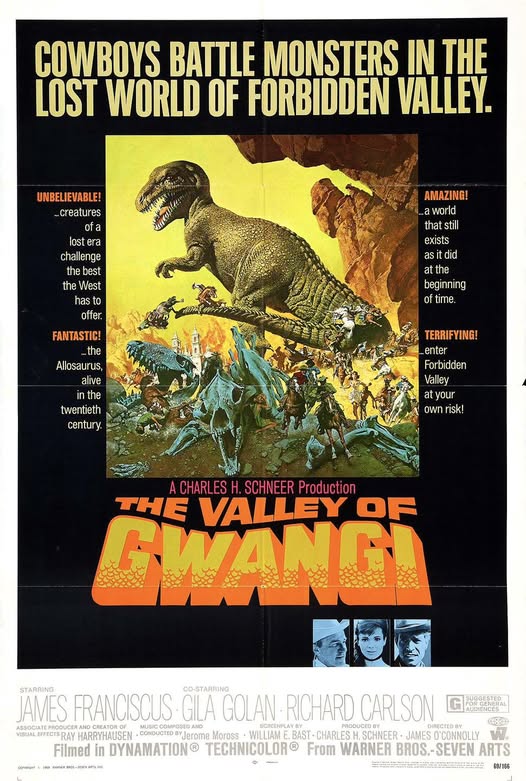
Before Cowboys & Aliens, there were cowboys and dinosaurs…
The Valley of Gwangi was a dream project of master of special effects Willis O’Brien, him of 1933’s King Kong fame. O’Brien tried for years to make the movie a reality, but died in 1962 failing to do it. The project, about cowboys fighting prehistoric creatures at the beginning of the 20th century, was then taken over by the legendary Ray Harrihausen, friend and disciple of O’Brien, himself a master of movie magic and stop-motion, who partnered with producer Charles H. Schneer and Warner Bros. to finally bring it to the screen in 1969, helmed by British director Jim O’Connolly, who had extensive experience in cinema and TV.
The story starts in Mexico, em 1912, where our hero, cowboy Tuck Kirby (James Franciscus, one year before going Beneath the Planet of the Apes) tries to reacquaint himself with old flame T.J. Breckenridge (Gila Golan, an Israeli beauty that had all her lines dubbed due to her heavy accent). T.J. is the owner of a carnival that is not going well financially, but that could have a change of luck by using in the show a miniature pre-historic horse brought over from a mysterious and forbidden valley nearby. When the little horse is kidnapped by local gypsies that fear “the curse of Gwangi” and plan to take the animal to the valley, Tuck, T.J. and others try to rescue it, they all enter the valley along with cheerful but untrustworthy paleontologist Professor Bromley (Laurence Naismith, soon to be in TV classic The Persuaders) and young Lope (slightly annoying child actor Curtis Arden).
In the valley, soon the troupe gets face to face with the million-of-years-old creatures that the audience had to wait almost 45 minutes to finally meet. Exactly three of them: a pteranodon, a ornithomimus and a vicious styracosaurus, the Gwangi of the title. Why these beasts are not extinct? The screenplay, by William Bast, Julian Moore and O’Brien, doesn’t explain. Why we see only three of them? There are more? No one seems interested in answering these questions.
Anyway, realising a living dinosaur is way better to attract money to the Carnival than the small horse (that vanishes halfway through anyway), the cowboys capture Gwangi and take it to the city, where the beast obviously escapes and brings chaos, death and destruction.
It is a fun concept, but not a great movie. The main attraction, the special effects, only work well here and there. Harryhausen integrated humans and monsters much better in previous jobs, like the amazing Jason and the Argonauts (1963). In The Valley of Gwangi, sometimes when a dinosaur interacts with humans, the image gets blurred and the effect (pardon the pun) is not very credible. Also, the climactic battle with Gwangi could be more impressive.
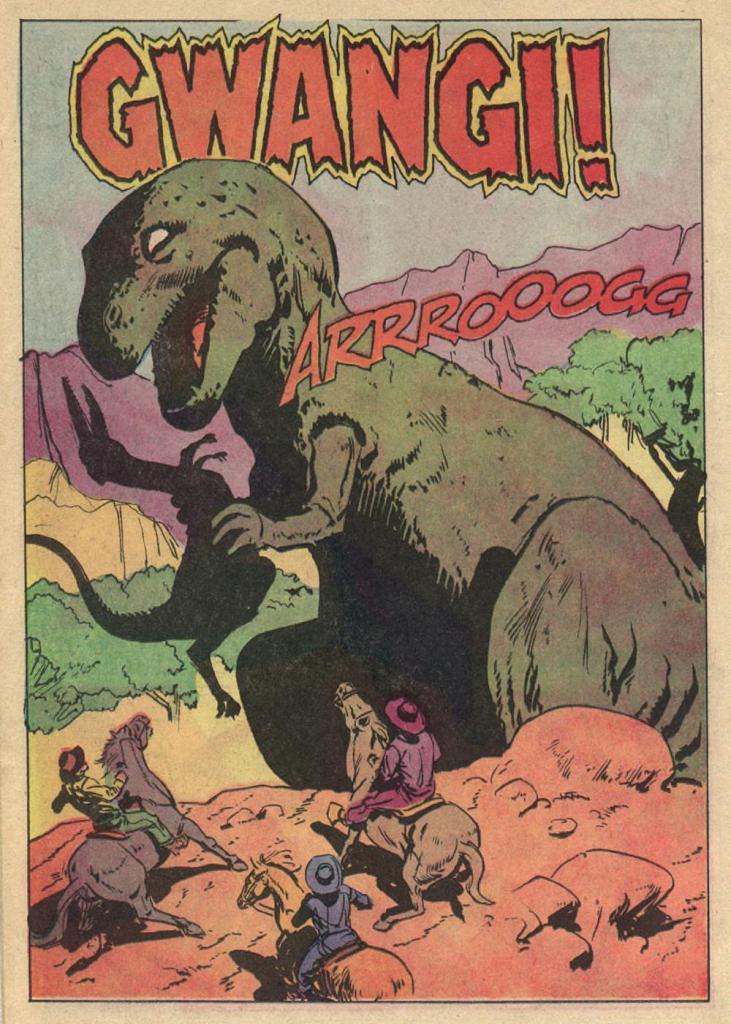
According to the producers, they had a diminished budget and bad marketing due to some internal changes at Warner and it affected the overall quality. Unfortunately, it probably had an impact on the box office, since the movie was not the hit everybody expected —even Dell Publishing, that released a very good tie-in comic book adaptation pencilled by artist Jack Sparling. The comic actually looks better than the movie.
It is not a bad movie, it has its charms. But, if you loved this as a kid in the 1970s and revisits it now, there is a big chance you will most likely end up a little disappointed.
The Valley of Gwangi (1969, Warner Bros.)
Starring James Franciscus, Gila Nolan, Laurence Naismith
Directed by Jim O’Connolly
96 minutes
Rating: 6 Nerds (out of 10) 😎😎😎😎😎😎
Did you enjoy it? Give it a like and leave a comment!

